
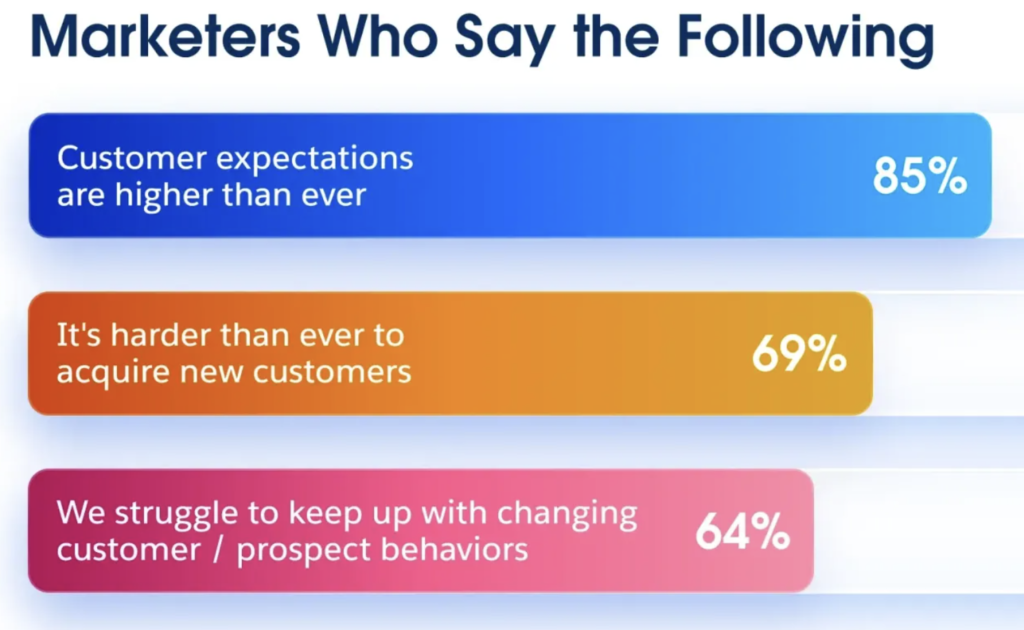
In today’s fast-evolving marketing landscape, customer expectations have shifted dramatically towards authentic, two-way interactions. According to a recent Salesforce survey highlighted by MarTech, an overwhelming 83% of marketers recognize that customers want dialogue rather than one-sided messaging. Yet, nearly seven in ten admit they cannot respond quickly enough to sustain these conversations. This growing disconnect between expectation and execution reveals pivotal challenges, and opportunities, for marketing professionals navigating the AI revolution.
Key Takeaways
- 83% of marketers acknowledge customers desire two-way communication.
- 69% report struggling with timely responses to customer inquiries.
- 75% of organizations are using at least one form of AI in their marketing efforts.
- 81% of marketers trust AI tools to handle customer interactions.
- Lack of unified and accessible customer data hampers personalization and relevance.
The Critical Role of Data Integration in Effective AI-Driven Dialogue
The Salesforce report underscores a fundamental reality: while AI adoption is widespread, three out of four marketing teams employ some form, execution often falls short due to fragmented data ecosystems and legacy workflows. Simply deploying AI tools does not guarantee meaningful engagement. Without unified, contextualized customer data spanning service, sales, and commerce departments, even the most advanced algorithms falter when predicting behavior or delivering relevant responses.
This fragmentation means that although AI can operate at scale and provide rapid replies around the clock, those responses may feel generic or disconnected from individual needs, leading to diminished trust and weaker brand relationships. The fact that 84% of marketers concede their campaigns still appear generic highlights this persistent gap between technological potential and practical outcomes.
Marketers must therefore prioritize building integrated data architectures that enable seamless information flow across organizational silos. Such integration empowers AI systems not only to react swiftly but also intelligently, to discern context, anticipate next-best actions, and foster genuine dialogue that resonates on a personal level.
Practical Tips
- Invest in Data Unification: Audit existing data silos across departments; implement CRM platforms or middleware solutions that consolidate customer insights into a single source of truth.
- Develop AI Fluency: Train marketing teams on interpreting AI outputs critically; empower staff with skills to guide algorithms toward strategic goals rather than relying solely on automation.
- Leverage Conversational AI Strategically: Use chatbots or virtual assistants for initial touchpoints but ensure escalation paths exist for complex queries requiring human empathy or decision-making.
- Create Feedback Loops: Regularly analyze interaction outcomes to refine both your data inputs and conversational models based on real-world performance metrics.
What This Means for Small & Local Businesses
The pressure to maintain active dialogues with customers is not exclusive to large enterprises; small businesses face similar demands with fewer resources. While adopting cutting-edge technology may seem daunting, small-scale investments in integrated CRM systems combined with accessible conversational tools can yield significant returns by enhancing responsiveness without inflating costs.
A pragmatic approach involves starting small: automate routine FAQs through chatbots while gradually integrating sales and service data streams for richer personalization over time. Moreover, cultivating team capabilities around interpreting analytics ensures continuous improvement without overwhelming limited staff capacity.
This focus on scalable solutions enables local businesses not only to meet rising expectations but also differentiate themselves through more meaningful connections—a crucial advantage where community reputation drives sustained growth.
