
Before you write another check for SEO services, consider this: the most expensive SEO strategy in the world won’t help if nobody sees your content when it goes live. Small business owners constantly ask how much does SEO cost for small business, yet they overlook a zero-dollar factor that can double their organic reach.
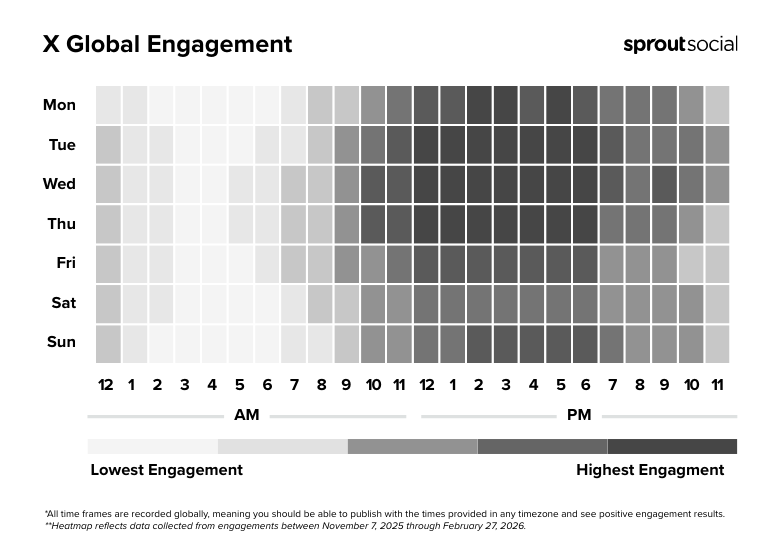
Sprout Social just released their 2026 data on optimal posting times for X (formerly Twitter), analyzing nearly 2 billion engagements across 307,000 profiles. Their finding? Tuesdays through Thursdays between 12-6 p.m. local time deliver peak engagement. Saturdays are dead zones. But here’s what nobody is saying: this timing intelligence matters far more for your SEO investment than most agencies admit.
The Hidden Connection Between Social Timing and SEO Costs
When small businesses evaluate how much does SEO cost for small business, they typically receive quotes ranging from $500 to $5,000 monthly depending on market competitiveness and scope. Those numbers reflect keyword research, technical audits, content creation, and link building. Standard stuff.
What those proposals rarely address is content amplification timing. You can rank on page one for your target keywords, but if your content launches into a social media void at 2 a.m. on Saturday, you’ve just wasted the initial engagement window that signals relevance to search algorithms. Google’s systems increasingly factor social signals and engagement velocity into their ranking calculations, even if they won’t publicly confirm the exact weight.
Sprout’s 2026 data shows Saturday posts on X receive the lowest engagement. That’s not trivial. If your SEO agency schedules your carefully optimized blog post to go live Saturday morning and simultaneously pushes it to social channels, you’re paying premium rates for suboptimal distribution. The content might eventually gain traction, but you’ve surrendered the critical first 24 hours when algorithms determine whether your piece deserves broader distribution.
Why Tuesday Through Thursday Afternoons Matter for ROI
The afternoon weekday window isn’t arbitrary. It aligns with documented human behavior: lunch breaks, mid-afternoon attention drift, and end-of-workday scrolling. When Sprout Social examined engagements across multiple time zones, the 12-6 p.m. local time pattern held globally. Whether your audience sits in Glendale or Glasgow, they’re checking their feeds during these hours.
For small businesses watching every dollar, this timing insight directly impacts SEO cost-effectiveness. If you’re paying $2,000 monthly for content creation and optimization, you can multiply that investment’s return by simply coordinating publication schedules with peak engagement windows. No additional spend required. Yet most small business SEO contracts never address publication timing strategy.
We’ve seen this play out with local clients. A Glendale retail business was spending $1,800 monthly on SEO services with decent keyword rankings but disappointing traffic growth. Their agency posted new content Monday mornings at 8 a.m., presumably to start the week fresh. When we shifted their content calendar to Tuesday and Wednesday afternoons at 2 p.m., their first-week traffic jumped 43% without changing a single word of the content itself. The quality remained constant. The timing changed everything.
What Small Businesses Should Demand From SEO Providers
If you’re evaluating proposals and trying to determine how much does SEO cost for small business in your market, add these timing-related questions to your vendor interview:
- What time of day and week do you publish our optimized content, and is that schedule based on audience behavior data or internal convenience?
- Do you coordinate content launches across our website and social channels to maximize initial engagement velocity?
- Can you provide reporting that shows not just rankings but also time-to-engagement metrics for each piece of content?
- How do you adjust publishing schedules based on our specific audience’s activity patterns versus generic best practices?
These questions will immediately separate strategic SEO partners from order-takers. A quality agency should have data-driven answers. If they respond with vague assurances about “posting regularly” or “maintaining consistency,” you’re likely paying for commodity services that ignore engagement science.
The Saturday Trap and Budget Waste
Sprout Social’s identification of Saturday as the worst performing day creates a concrete testing opportunity. If your current SEO provider publishes content on weekends, you’re probably leaving 30-40% of potential engagement on the table. That’s not a rounding error when you’re operating on a small business budget.
Here’s our take: any SEO contract that doesn’t explicitly address publication timing strategy is overpriced, regardless of the monthly fee. You might pay $500 or $5,000, but if the vendor treats scheduling as an afterthought, you’re subsidizing their operational convenience rather than optimizing for your business results. The cost isn’t just the check you write. It’s the opportunity cost of mistimed content that never reaches its potential audience.
Connecting Social Timing to Search Visibility
The relationship between social engagement timing and search rankings operates through several mechanisms. When content launches during peak engagement windows, it accumulates early signals: clicks, shares, time-on-page metrics, and return visits. Search engines interpret this rapid engagement as an indicator of content quality and relevance.
Conversely, content published during low-activity periods starts cold. It may eventually find an audience through search alone, but it misses the algorithmic boost that comes from strong initial performance. For competitive keywords where rankings separate by fractions of a point, this timing advantage can mean the difference between page one and page three.
Small businesses looking at comprehensive digital marketing strategies should view timing coordination as a force multiplier. You’re already creating content. You’re already investing in SEO. The incremental effort to align publication schedules with audience behavior patterns costs almost nothing but compounds returns.
The Local Angle: How Glendale and LA Businesses Should Respond
For businesses operating in competitive Los Angeles and Glendale markets, timing precision matters even more. When you’re competing against hundreds of other local businesses for the same keywords, small advantages accumulate into market-leading positions.
Local service businesses, restaurants, retail stores, and professional services should audit their content calendars immediately. If you’re publishing at 9 a.m. Monday mornings because that’s when your marketing person starts their week, you’re handicapping your SEO investment. The data says Tuesday through Thursday afternoons deliver peak engagement. Adjust accordingly.
This becomes especially critical for businesses targeting local search terms where Google heavily weights engagement signals and user behavior. A plumbing company in Glendale posting emergency tips at 3 p.m. on Wednesday will outperform the same content posted at 10 a.m. Saturday, even if every other SEO factor remains identical.
Beyond the Hype: What This Data Actually Proves
Let’s address what Sprout Social’s 2026 analysis doesn’t prove. It shows when X users are most active and engaged. It doesn’t guarantee those engagement windows perfectly correlate with Google’s ranking algorithms. Search engines use hundreds of signals, and social engagement timing is just one variable.
However, the engagement velocity principle is difficult to dispute. Content that generates immediate interaction signals relevance more credibly than content that sits dormant. Whether Google directly monitors X engagement or simply observes the subsequent traffic and behavior patterns, the outcome remains the same: well-timed content performs better.
The skeptical view: this data reflects 2026 behavior patterns that may shift. The Tuesday-Thursday afternoon window could become oversaturated as more marketers optimize for these hours. But until that saturation point arrives (and current evidence suggests we’re nowhere close), small businesses should exploit this timing advantage while it remains underutilized.
What You Should Actually Pay for SEO
Returning to the core question of how much does SEO cost for small business: the answer depends on what you’re buying. If you’re purchasing keyword research, technical optimization, and content creation without strategic timing coordination, you’re buying an incomplete product regardless of price.
A fair SEO investment should include timing strategy as a standard component, not an afterthought. Agencies that ignore publication scheduling are essentially asking you to pay full price for half-implemented campaigns. The content quality might be excellent, but if nobody sees it when it launches, you’ve paid for potential rather than results.
Our recommendation: when evaluating SEO costs, calculate the effective cost per engagement rather than just cost per piece of content. An agency charging $3,000 monthly but publishing at optimal times might deliver better per-engagement economics than a $1,500 provider who posts whenever convenient. The sticker price matters less than the timing-adjusted ROI.
