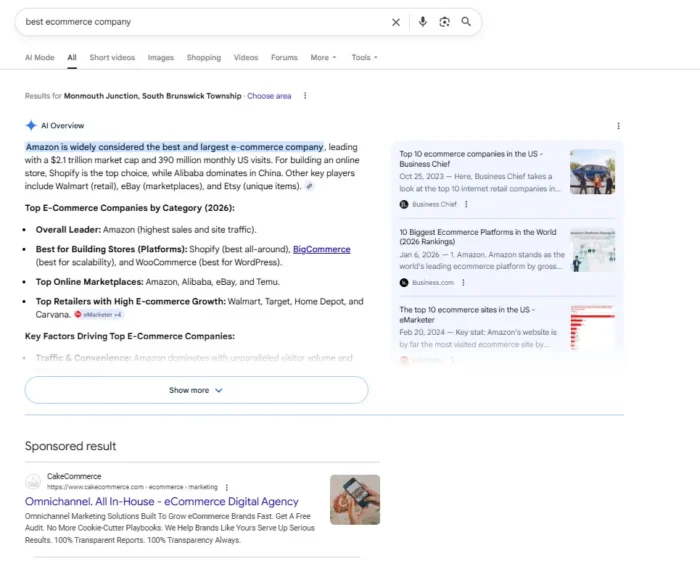
Your search ads are getting impressions. But clicks are falling off a cliff. The reason? AI Overviews now answer questions before users ever reach your content. For teams debating content marketing vs SEO which is better, this shift changes the entire calculation. When Google’s AI-generated summaries sit at the top of search results, solving problems without a single click, you need to rethink where and how you show up.
The Click Collapse That Changed Search Strategy
Research from Seer Interactive found that paid search click-through rates drop to 9.87 percent when AI Overviews appear, compared to 21.27 percent on the same queries without them. That’s a 53.6 percent traffic reduction. We have seen similar patterns with our own clients. Impression counts stay steady or even climb, but clicks become harder to earn.
The SERP layout explains why. AI Overviews occupy prime real estate at the top of results pages. Users scroll past a detailed AI-generated answer before they encounter paid ads or organic listings. Ads that once captured attention in the top slot now sit below a comprehensive AI summary. Organic results that used to dominate position zero now compete with machine-generated content that pulls from multiple sources at once.
Which Search Intent Survives AI Summaries
Not all queries face the same threat. Informational searches like “how to fix a leaky faucet” or “what causes lower back pain” are most vulnerable. AI Overviews answer these questions directly in the SERP, eliminating the need for users to visit a website. The AI solves the research intent right there.
Transactional queries hold up better. When someone searches “buy running shoes near me” or “plumber in Glendale,” they are not looking for information. They want to take action. AI Overviews appear less frequently for these searches, and when they do, they still push users toward businesses that can fulfill the intent. Brand searches remain largely unaffected because users already know where they want to go.
This distinction matters when teams ask content marketing vs SEO which is better for their budget. If your business relies on capturing informational search traffic and converting readers later in the funnel, you face a steeper challenge in 2026. If you target high-intent commercial searches, traditional SEO and paid search still deliver consistent returns. But pure informational content without a clear path to conversion becomes harder to justify.
Why Impression Share Now Matters More Than CTR
Click-through rate used to be the primary health metric for paid search campaigns. Not anymore. When impressions rise but clicks fall because of AI Overviews, CTR alone gives you an incomplete picture. We have started tracking impression share as a leading indicator of visibility, even when clicks do not materialize immediately.
The logic: if your ads appear in the SERP alongside an AI Overview, you are still building brand awareness. Users see your name, your offer, your positioning. They may not click today, but they register your presence. In a world where AI answers reduce immediate click behavior, brand recall becomes more valuable. Measurement frameworks need to account for this shift.
Attribution models also need updating. A user might see your ad in a SERP with an AI Overview, read the AI summary, then search for your brand directly a day later. That brand search should connect back to the original impression, but most attribution systems do not track it that way. Teams running Google Ads campaigns need to expand reporting to include impression-based metrics and assisted conversions, not just last-click attribution.
How to Adapt Your Content and Paid Strategy Now
Teams that react fastest are reallocating budgets and rethinking targeting. Here are four adjustments we recommend:
1. Shift budget toward transactional keywords. If informational queries lose 50 percent of their clicks, move spend to high-intent searches where AI Overviews appear less often or where users still need to visit a site to complete a purchase. Focus on bottom-of-funnel terms with clear commercial intent.
2. Expand beyond search. Search is no longer a standalone channel. Users discover answers across YouTube, Reddit, TikTok, and AI platforms like ChatGPT. Brands that capture demand earlier in the research process, on platforms where AI summaries do not dominate, gain an advantage. We have seen clients successfully test YouTube pre-roll and Reddit ads to reach users before they hit Google.
3. Build content that AI cannot replicate. Original data, proprietary insights, and first-person expertise are harder for AI to summarize. If you publish the same listicle that appears on fifty other sites, AI Overviews will absorb your content and display it without sending traffic your way. But unique case studies, survey results, and specific client outcomes still drive clicks because they offer information that exists nowhere else. This is where the debate about content marketing vs SEO which is better shifts: you need both, but content must be distinctly yours.
4. Test AI-native platforms. Google is not the only game in town. Perplexity, ChatGPT, and other AI answer engines are becoming legitimate search alternatives. Some advertisers are testing placements within these platforms or optimizing content to appear in their reference lists. Early movers gain positioning before competition saturates these channels.
Content Marketing vs SEO: Which is Better When AI Controls Discovery
The old framework treated SEO as the technical foundation and content marketing as the creative layer on top. You optimized for keywords, built backlinks, then wrote content to rank. That model assumes users will click through to your site. When AI Overviews answer questions without requiring a click, the value equation changes.
Our take: asking content marketing vs SEO which is better misses the point in 2026. You need integrated SEO strategy that prioritizes brand authority and first-party assets over generic informational content. SEO still drives visibility, but content needs to serve goals beyond ranking for single keywords. Content must build brand, establish expertise, and create reasons for users to visit your site directly rather than relying on search alone.
Think of it this way: SEO gets you into the SERP. Content gives users a reason to choose you over the AI summary. If your content simply restates information available elsewhere, AI will replace you. If your content offers perspective, data, or solutions that AI cannot synthesize, you stay relevant.
For Small and Local Businesses
Not every business has budget to test Reddit ads or build proprietary datasets. If you run a local service business or a small ecommerce store, focus on two things: transactional keywords and local intent. Searches like “emergency plumber Glendale” or “buy custom birthday cakes near me” still drive clicks because users need a business to fulfill the request, not just information.
Invest in Google Business Profile optimization, local citations, and content that ties to your service area. AI Overviews do appear for local searches, but they still link out to businesses that can serve the customer. Make sure your business is the one that shows up. Skip the generic blog posts about “how to choose a plumber.” Focus on service pages, case studies, and reviews that demonstrate why someone should call you.
Sources
- Are AI Overviews Stealing Your Clicks? How Paid Search Teams Are Adapting to the Answer Engine Era – Neil Patel
