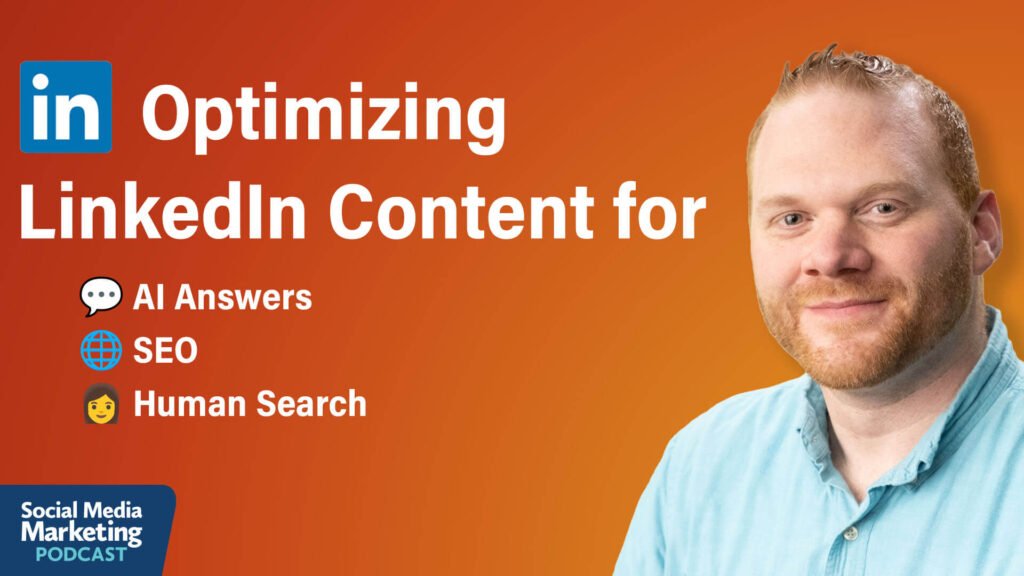
LinkedIn is rewriting its content to rank in ChatGPT search results, and the principles behind that shift reveal something useful for anyone writing paid search campaigns. When AJ Wilcox reports that 30-40% of his leads now come from AI tool referrals, he is not just documenting a platform change. He is showing us what happens when content gets optimized for both human attention and machine interpretation. That dual optimization strategy applies directly to your Google Ads account.
Why LinkedIn’s Reading Level Matters for Your Ad Copy
LinkedIn recommends writing at a ninth- through eleventh-grade reading level for organic content. Wilcox writes his ads at a fifth-grade level. Not because his audience lacks sophistication, but because busy professionals skim. Your message has to land in a quick pass. This principle has guided our approach at Atmos Digital for years, but seeing it validated by platform-level data reinforces how critical simplicity remains.
When you write at a fifth-grade level, you strip out unnecessary modifiers, shorten sentences, and focus on concrete benefits. The same reader who will spend twenty minutes on a detailed case study will bounce from an ad in three seconds if the value is not immediately clear. Your character count is limited. Every word has to work.
How to Write Effective Google Ads Copy Using AI-Optimized Principles
The techniques LinkedIn is using to make content machine-readable translate directly to paid search. Here is how to apply them when writing ads that perform for both human searchers and the AI systems increasingly mediating discovery.
Use semantic clarity. LinkedIn is adding semantic markup to help LLMs understand content meaning and purpose. In your ads, that means using the exact language your audience uses. If they search for “plumber near me,” your headline should say “Local Plumber” not “Residential Water System Technician.” Match the search term. AI systems reward directness because they are trained to connect user intent with content that satisfies it explicitly.
Front-load the benefit. Wilcox notes that LinkedIn posts have an active shelf life of two to three days before human engagement dies out. Your ad has about three seconds. Put the most compelling benefit in the first headline. “Save 40% on HVAC Repairs” beats “Trusted HVAC Service Since 1998” because the financial benefit registers faster than the trust signal. You can include trust elements in description lines, but the headline has to stop the scroll.
Write for skimmers. Busy professionals skim. So do searchers evaluating six ads in a results page. Break up description lines with clear benefit statements. Use numbers when possible. “15-Minute Response Time” scans faster than “We respond quickly to all service calls.” Concrete details beat vague promises every time. This approach to Google Ads management consistently outperforms generic brand messaging in our client accounts.
Test readability tools. Run your ad copy through the Hemingway Editor or a similar readability checker. If it scores above eighth grade, simplify it. Replace “utilize” with “use.” Cut adverbs. Remove hedging language like “helps to” and just state the benefit directly. We have seen click-through rates improve by 15-20% when clients simplify copy that initially tested at eleventh-grade level down to sixth or seventh.
The Two-Audience Problem: Humans and Algorithms
LinkedIn’s strategy of creating both feed posts and newsletter articles for the same content reveals a useful framework. Feed posts drive immediate human engagement. Newsletter articles remain permanently accessible to AI tools. You face a parallel challenge in paid search: writing for the human who clicks and the algorithm that decides whether to show your ad.
Google’s ad ranking system evaluates expected click-through rate, ad relevance, and landing page experience. The algorithm looks for semantic connections between search terms, ad copy, and landing page content. When someone searches “emergency dentist,” your ad should include that exact phrase, and your landing page should reinforce it in the headline and first paragraph. That coherence signals relevance to the algorithm.
But humans need more than keyword matching. They need a reason to click your ad instead of the five others on the page. That is where benefit-focused copy and specific claims separate performance. “Emergency Dentist Available Now” plus “Same-Day Appointments, No Referral Needed” gives both the algorithm its keyword match and the human a compelling reason to choose you.
How to Write Effective Google Ads Copy That Converts
Visibility alone does not pay the bills. Your ads need to convert searchers into customers. Here is how to structure copy that moves people from click to contact.
Match search intent precisely. If someone searches “buy running shoes online,” they want to make a purchase now. Your ad should say “Shop Running Shoes” with a clear path to product pages. If they search “best running shoes for flat feet,” they are still researching. Your ad might say “Running Shoe Buying Guide” and link to educational content. The intent behind the search dictates the promise in your ad.
Include a friction-reducer. Every purchase involves perceived risk. Address it directly in your ad copy. “Free Returns” reduces financial risk. “24/7 Support” reduces operational risk. “1,000+ 5-Star Reviews” reduces social risk. Identify the most common objection for your category and neutralize it in the description line.
Create urgency without desperation. “Limited Spots Available” works better than “Act Now Before It’s Too Late.” The first implies genuine scarcity. The second sounds like a late-night infomercial. Specific deadlines convert better than vague pressure: “Spring Sale Ends April 15” outperforms “Sale Ending Soon” because it gives the searcher a concrete reason to act today.
Test CTAs systematically. “Get Started” and “Learn More” are defaults, but they rarely perform best. We have seen “Schedule Free Consult,” “Get Instant Quote,” and “Download Guide” each outperform generic CTAs by 25% or more in specific accounts. The right CTA depends on your audience’s readiness to buy and the complexity of your offering. Professional services often convert better with consultation-focused CTAs. E-commerce typically wins with purchase-oriented language.
What LinkedIn’s AI Strategy Reveals About Paid Search’s Future
Wilcox’s observation that AI referrals jumped from 2-3 per week to 30-40% of all leads in roughly six months shows how quickly AI-mediated discovery is reshaping traffic sources. Google has integrated AI Overviews into search results. Microsoft is embedding Copilot across its properties. The algorithm deciding whether to show your ad increasingly relies on semantic understanding, not just keyword matching.
That shift rewards clarity and punishes vagueness. When you write paid search campaigns that use precise language, state benefits explicitly, and match user intent directly, you are optimizing for both current algorithms and the AI systems replacing them. The fundamentals have not changed. Clarity and relevance always won. The stakes for executing those fundamentals have just gotten higher as AI tools become the primary interface for discovery.
For Small and Local Businesses
You do not need a massive budget or a dedicated copywriter to implement these principles. Start by auditing your current ad copy through a readability tool. Aim for seventh-grade level or below. Next, list the three most common objections your prospects have before buying. Address one in each ad’s description line. Finally, test specific CTAs that match where your audience is in the buying process. A local contractor might test “Get Free Estimate” against “See Our Recent Projects.” A professional service might test “Schedule Discovery Call” against “Download Service Guide.”
The businesses winning in paid search right now are not necessarily outspending competitors. They are out-testing them. Run two ads per ad group. Give each version two weeks and 100 clicks minimum. Keep the winner, write a new challenger, repeat. That systematic approach to learning how to write effective Google Ads copy compounds over time. Small improvements in click-through rate and conversion rate multiply across hundreds or thousands of clicks per month.
