
Most businesses ask the wrong question when they start thinking about SEO. They want to know if they should optimize for local or national reach, but they have no framework for making that decision. They guess based on budget or what competitors are doing. That approach wastes money.
Why Analytics Determines Your SEO Direction
- Your current customer base reveals where demand actually exists, not where you think it should be
- Conversion data shows whether proximity matters for your product or service category
- Engagement patterns indicate if your audience searches with location intent or product-focused queries
- Competitive analysis exposes gaps in your market that make local or national targeting more viable
- Budget reality dictates whether you can afford to compete nationally or should dominate locally first
The Data Framework That Answers Local SEO vs National SEO Which Is Right for My Business
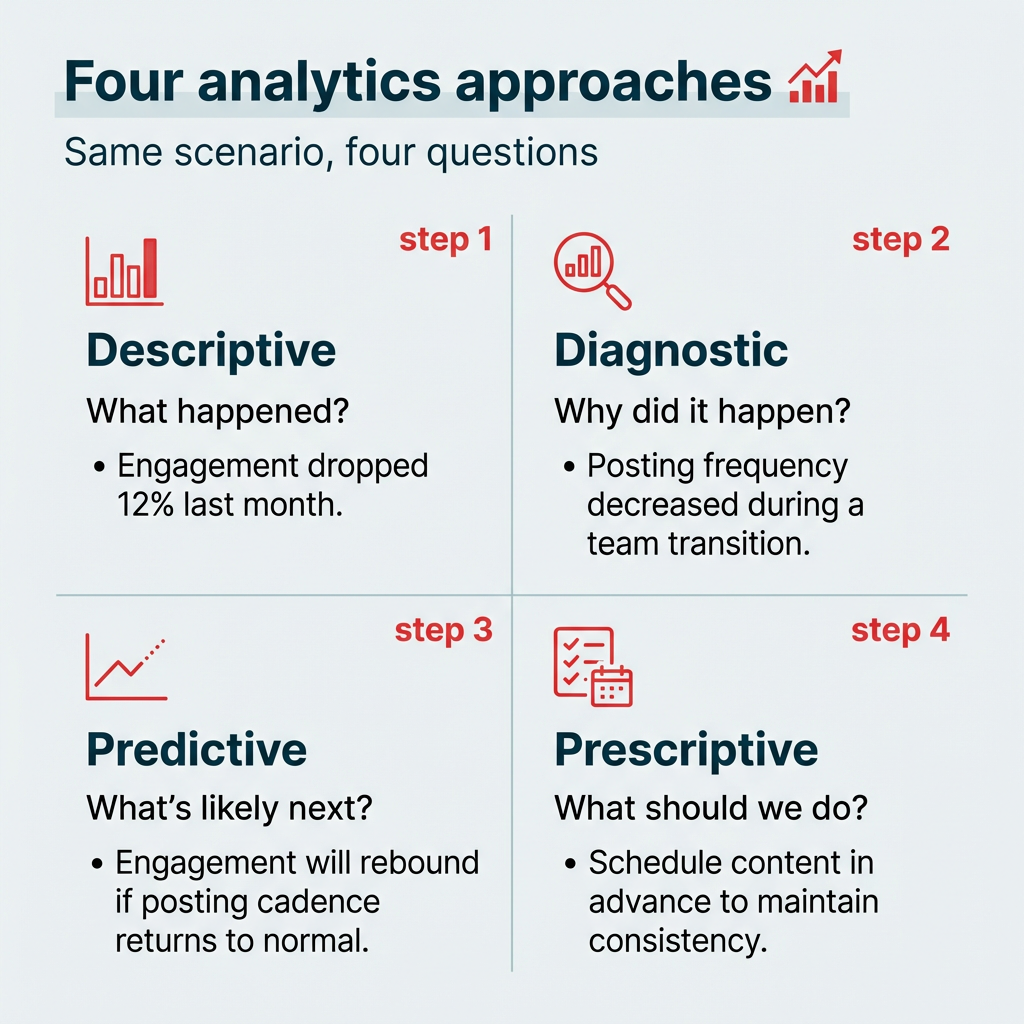
Hootsuite’s recent analytics guide outlines four analytical approaches: descriptive (what happened), diagnostic (why it happened), predictive (what comes next), and prescriptive (what to do about it). These same principles apply when choosing between local and national SEO strategies.
Start with descriptive analysis. Where do your current customers come from? Pull your Google Analytics data for the past six months. If 80% of your revenue comes from within 25 miles of your location, you have your answer. A Glendale restaurant owner does not need to rank for ‘best Italian food’ nationally. They need to own ‘Italian restaurant Glendale’ and related local queries.
Move to diagnostic analysis. Why are customers concentrated in specific areas? A plumber gets local customers because the service requires physical presence. An online course creator might get 90% of traffic from outside their state because the product has no geographic constraints. The why matters more than the what.
We worked with a Los Angeles furniture maker who initially wanted national SEO because ‘everyone sells furniture online now.’ The data told a different story. Their average order value was $3,200. Customers wanted to see pieces in person before buying. Shipping costs killed margins on distant orders. Local SEO brought customers who drove to the showroom, touched the wood, and bought same-day. Revenue increased 34% in four months by focusing on LA-area searches instead of diluting budget across national keywords.
Five Signals That Point to Local SEO Strategy
Your business likely needs local SEO if these conditions apply:
- Service delivery requires physical proximity. Contractors, medical practices, salons, and restaurants depend on customers who can reach them. National rankings do not help a dental office in Burbank.
- Your Google Analytics shows concentrated geographic demand. When 70%+ of conversions come from one metro area, optimize for that area. Do not chase the 5% of traffic from distant states.
- Customer lifetime value justifies local domination. If you can generate $50,000 annual revenue from 20 local clients, ranking first for local terms beats ranking 15th for national ones.
- Competition is fragmented locally. National brands often ignore local optimization. A well-executed local SEO strategy can outrank national competitors in your market because you focus where they do not.
- Your budget is under $3,000 per month. National SEO requires competing against companies spending $20,000+ monthly on content, links, and technical optimization. Local SEO lets you win with smart execution and limited resources.
Five Signals That Point to National SEO Strategy
Consider national SEO when these factors are present:
- Your product ships anywhere with no friction. Software, digital courses, e-commerce products, and consulting services work regardless of customer location. Geographic targeting limits your market artificially.
- Search volume for your non-geo keywords is substantial. If ‘project management software’ gets 40,000 monthly searches and ‘project management software Los Angeles’ gets 90, the national term offers more opportunity despite higher competition.
- Your customer acquisition cost supports national campaigns. If you spend $200 to acquire a customer worth $2,000 in lifetime value, you can afford to compete nationally. If your margins are thin, national competition will bleed you dry.
- You have content resources to produce at scale. National SEO requires 4-8 high-quality content pieces monthly, ongoing link building, and technical optimization. Budget $5,000+ monthly or do not bother.
- Analytics show national demand. When customers from 40+ states convert at similar rates and your product scales without geographic constraints, local focus leaves money on the table.
How to Use Social Media Analytics to Validate Your SEO Choice
Social media data reveals demand signals that guide local SEO vs national SEO which is right for my business decisions. Here is how to extract those insights:
Check audience demographics in Facebook and Instagram Insights. Where do your engaged followers live? A Los Angeles yoga studio with 85% local followers should pursue local SEO. An online fitness program with followers distributed across 30 states needs national optimization.
Analyze which content gets shared and saved. When local event posts generate 3x more engagement than general tips, your audience values proximity. When educational content performs regardless of location references, geography matters less.
Review direct message patterns. We had a client receiving 60+ DMs monthly asking ‘Do you serve [distant city]?’ That data indicated national demand their local-focused strategy was missing. They shifted to national SEO and revenue doubled in eight months.
Track which posts drive website traffic. If your Google Analytics shows social referrals coming primarily from one metro area, align your SEO strategy to that same geography. If social traffic is nationally distributed, your SEO should match.
Sentiment analysis matters too. According to the Hootsuite guide, understanding how people talk about your brand helps refine strategy. Local businesses often see mentions tied to specific locations: ‘Best service in Pasadena’ or ‘Finally found this in Glendale.’ National brands get mentions focused on product attributes without location modifiers. The language customers use reveals whether they think of you as a local or national option.
The Hybrid Approach Most Businesses Actually Need
Here is what nobody tells you: the question is not local SEO vs national SEO which is right for my business. It is which one do you prioritize first.
Most businesses benefit from a tiered approach. Dominate your local market, prove the model works, then expand nationally. A Glendale marketing agency should own ‘digital marketing agency Glendale’ and ‘marketing services Los Angeles’ before chasing ‘digital marketing services’ nationally. Win where you can win, then scale.
The analytics tell you when to shift gears. When local keywords reach page one and traffic plateaus, when you have captured most available local market share, when customer acquisition cost for local campaigns rises above target – those signals indicate readiness to add national keywords.
Start tracking these metrics now: percentage of traffic from target geography, conversion rate by location, customer acquisition cost by channel, share of voice in local vs national search results. These numbers make the decision obvious.
What This Means for LA Businesses
Los Angeles businesses face unique challenges in this local vs national decision. The LA market is massive – you can build a seven-figure business serving only Los Angeles County. A plumber, attorney, or restaurant does not need national SEO when 10 million potential customers live within your service area.
But LA is also home to businesses with national reach: entertainment companies, tech startups, e-commerce brands. If your customer base extends beyond Southern California, do not artificially limit yourself with only local optimization. Use the data framework above to make the choice based on evidence. Our SEO services start with this analytical foundation because strategy without data is just expensive guessing. Track where your revenue comes from, understand why customers choose you, predict where growth opportunities exist, then build your SEO approach around those insights. The wrong choice costs you customers. The right choice, backed by analytics, compounds returns month after month.
