
Most marketers compartmentalize their channels. Instagram lives in the social media silo. SEO lives somewhere else entirely. That separation is costing you visibility.
nn
What Instagram’s 3 Billion Users Tell Us About Search Behavior
n
- n
- Instagram now matches WhatsApp at 3 billion monthly active users, making it the second-largest platform after Facebook
- Over 80% of Instagram users also use Facebook, creating massive cross-platform opportunities for brand discovery
- 62.3% of users actively research brands and products on Instagram before making purchase decisions
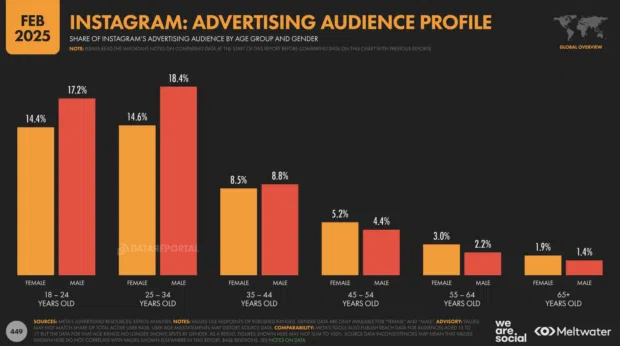
- The 25-34 age demographic dominates the platform, representing your prime search-and-buy audience
- Business accounts grow at 0.86% monthly, but that modest number masks what matters: consistent, compounding visibility
n
n
n
n
n
nn
Why Instagram Demographics Actually Impact Your Search Rankings
np>Here’s what the industry won’t tell you: Google doesn’t exist in a vacuum. The algorithm watches user behavior across the entire web. When someone discovers your brand on Instagram, then searches for you by name on Google, that branded search query sends a powerful signal. Google interprets it as relevance, authority, and user intent alignment.
nn
The 62.3% figure above matters more than most realize. Nearly two-thirds of Instagram users treat the platform as a research tool. They see your Reel, your Story, your carousel post. Then they Google you. That journey from social discovery to search query is exactly how you rank higher on Google without spending another dollar on backlinks.
nn
We’ve watched this play out with our own clients. A Glendale-based retailer increased their branded search volume by 340% in six months, not through traditional SEO services, but by aligning their Instagram content with what their 25-34 demographic actually wanted to see. More Instagram engagement led to more Google searches. More Google searches led to better rankings for their product category terms. The loop feeds itself.
nn
The Demographics That Actually Move the Needle
nn
Let’s cut through the noise. Not all demographic data deserves equal attention. The 25-34 age bracket dominates Instagram for a reason: purchasing power combined with digital fluency. This group doesn’t just scroll; they research, compare, and buy. When 70% of users say they’re on the platform to share photos and videos, that’s not vanity metrics. That’s user-generated content waiting to happen, which Google increasingly factors into local search rankings and review signals.
nn
The gender split sits nearly even, but that average hides regional variance. What matters isn’t the global number. It’s understanding your specific market. An LA-based business targeting women 25-34 needs different content than a B2B service provider chasing decision-makers 35-44. The demographics give you permission to stop creating generic content that pleases no one.
nn
Business account growth at 0.86% monthly sounds uninspiring until you remember compound effects. That’s 10% annually. Consistent visibility builds brand recall, which drives direct navigation and branded searches. Both are ranking factors Google cannot ignore.
nn
How to Rank Higher on Google Using Instagram Demographics
nn
- n
- Map your Instagram demographics to your target search queries. If your audience is 25-34 and you sell skincare, your Instagram content should answer the same questions they’re typing into Google. Create Reels that address ‘how to fix dehydrated skin’ or ‘best morning skincare routine.’ When users see you on Instagram first, they’ll search for you by name later.
- Use Instagram to generate branded search volume. Every piece of content should include your brand name prominently. Not as a logo in the corner, but in the caption, in your bio, in your hashtags. Make it impossible to forget who you are. Branded searches are the easiest ranking boost you’ll ever get.
- Align your Instagram posting schedule with search trends. Google Trends shows when people search for your keywords. Post Instagram content 24-48 hours before those search spikes. When someone sees your Reel on Monday and searches Tuesday, you’re ready to capture that intent.
- Repurpose your top Instagram content into blog posts. If a Reel gets 50,000 views, that topic has proven demand. Turn it into a 1,500-word blog post optimized for the same query. Link to it from your Instagram bio. Now you’re feeding Google exactly what Instagram proved your audience wants.
- Use Instagram to test content ideas before investing in SEO. A blog post takes hours. A Story takes minutes. Test your angles, your messaging, your hooks on Instagram first. The engagement data tells you what’s worth the SEO investment. Don’t write for keywords nobody cares about just because a tool said the search volume looks good.
- Build your Instagram presence around local search terms. If you’re targeting ‘digital marketing Los Angeles,’ your Instagram content should scream LA. Location tags, local landmarks in your photos, LA-specific pain points in your captions. Google connects those dots. Your digital marketing strategy should treat Instagram as a local SEO asset, not just a follower-counting game.
nn
nn
nn
nn
nn
n
nn
What This Means for LA Businesses
nn
Los Angeles runs on visual storytelling. Instagram isn’t optional here; it’s the price of entry. But too many LA businesses treat it as a vanity play, chasing followers and likes while their competitors quietly dominate Google. The smart move is recognizing that these channels work together. Your Instagram demographics show you who’s ready to buy. Your search rankings determine whether they find you when they’re ready to act.
nn
The 0.86% monthly growth figure should alarm you, not comfort you. If you’re growing slower than that, you’re losing ground. If you’re growing faster but not seeing corresponding lifts in organic search traffic, you’re building on sand. The goal isn’t Instagram growth for its own sake. The goal is turning social visibility into search authority, which turns into revenue. Everything else is just noise.
nn
Sources
n
- n
- 23 Instagram demographics marketers need to know in 2026 – Hootsuite
n
